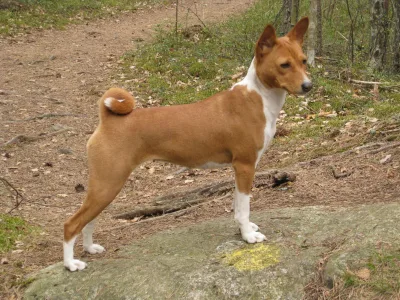
Basenji
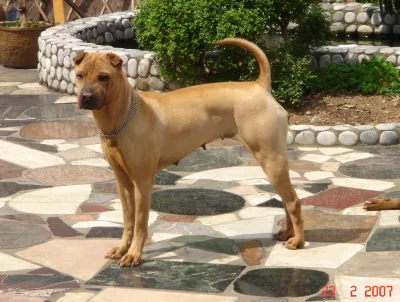
The Basenji is a breed of hunting dog created from stock that originated in Central Africa, including in the Republic of the Congo and other adjacent tropical African countries. The Fédération Cynologique Internationale places the Basenji in the Spitz and "primitive types" categories, while the American Kennel Club classifies it as a hound. The breed does not bark in the traditional manner of most dogs, rather vocalising in an unusual, yodel-like "talking" sound, due to its unusually-shaped larynx. This trait earns the Basenji its nickname of "barkless" dog, a similar feature seen and heard in the New Guinea singing dog. Basenjis are athletic small dogs that can run up to 30 to 35 miles per hour (48 to 56 km/h), and share many distinctive traits with the pye or pariah dog types of the Indian subcontinent. In addition to their uniquely similar vocalisations, the Basenji, the Australian dingo and the aforementioned New Guinea singing dog all only come into estrus once per year, as does the Tibetan Mastiff; other dog breeds may have two or more breeding seasons each year. Basenjis lack a distinctive odor, or "dog smell".
| Origin | DR Congo |
| Life Span | 13-14 years |
| Weight | 10-12 kg |
What to Know Before Buying a Basenji
Finding a responsible Basenji breeder requires more than browsing classified ads or responding to social media posts. The USDA requires any breeder who sells dogs commercially, especially those selling online or through third-party dealers, to hold a federal license and submit to regular inspections. A legitimate breeder should be willing to provide their USDA license number, invite you to visit their facility, and show you where the animals are housed and socialized.
Before committing to a purchase, ask the breeder for veterinary health records, vaccination documentation, and any genetic testing results relevant to the Basenji. Reputable breeders will also ask you questions in return, about your living situation, experience with animals, and ability to provide long-term care. A breeder who asks no questions and is eager to ship an animal immediately is a significant red flag.
Use the search tool below to check whether any USDA-licensed facilities breeding Basenjis appear in our database. If they do, review their inspection history carefully. Look for patterns of violations, pay attention to severity levels, and compare their compliance grade with other breeders in the same state. This due diligence takes minutes and can save you from supporting a facility with documented animal welfare problems.
Looking for a Basenji breeder?
Search our database of USDA-licensed facilities to find inspected breeders and check their compliance history.
Search USDA Breeders