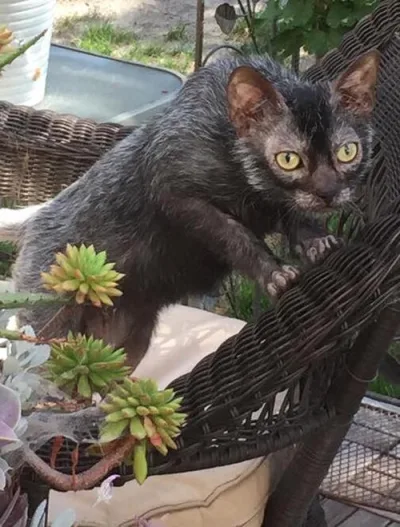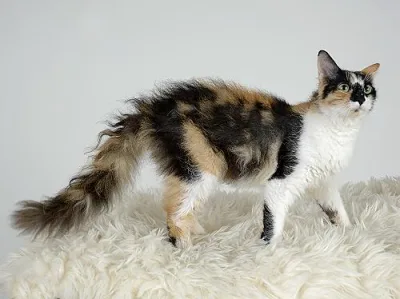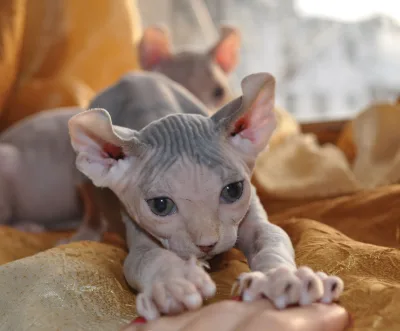
Elf cat
The following is a list of experimental cat breeds and crossbreeds that do not have the recognition of any major national or international cat registries, such as The International Cat Association (TICA) in the US, Europe, and Australasia; the Governing Council of the Cat Fancy (GCCF) in the UK, the Fédération Internationale Féline (FiFE) in continental Europe, the Cat Fanciers' Association (CFA) in North America, or the more recent World Cat Federation based in Germany. Such a breed may be recognized by one of the smaller cat registries. Smaller registries include the Rare and Exotic Feline Registry (REFR), and others. This list only includes breeds recognized by at least one extant, national or international, multi-breed registry. Breeders of some minority breeds actively seek major recognition for them, but have yet to receive it. For example, in regions where the formal cat fancy is in its infancy, naturally occurring native varieties – landraces – can be classified as minority breeds when attempts at selective breeding have begun to produce a formal natural breed with consistent traits, as is ongoing with the Aegean and Van cats. Other minority breeds are bred for private reasons and inadvertently attract an informal following. Minority breeds may be recognized by some registries, or none at all; recognition can be refused for a variety of reasons (including over-similarity to an existing breed, medical problems being statistically linked to the breed, and others). Some may have "preliminary" status in one or more registries, with experimental conformation standards already in place, but turn out to be non-viable over the longer term. Discrepancies between breed names can often cause confusion; occasionally the name adopted by one registry is used elsewhere for an entirely different breed; for example, the breed known in Australia as "Burmilla Longhair" is analogous to the "Asian Semi-longhair" in Britain (also called the "Tiffanie"), but Australia already has a quite different breed known as the "Australian Tiffanie" and both are different from the American "Tiffany" (also known as the Chantilly-Tiffany). Such conflicts are decreasing due to better communication between registries, largely facilitated by the Internet and by the World Cat Congress.
| Life Span | 12-18 years |
| Weight | 3-6 kg |
What to Know Before Buying an Elf cat
Finding a responsible Elf cat breeder requires more than browsing classified ads or responding to social media posts. The USDA requires any breeder who sells cats commercially, especially those selling online or through third-party dealers, to hold a federal license and submit to regular inspections. A legitimate breeder should be willing to provide their USDA license number, invite you to visit their facility, and show you where the animals are housed and socialized.
Before committing to a purchase, ask the breeder for veterinary health records, vaccination documentation, and any genetic testing results relevant to the Elf cat. Reputable breeders will also ask you questions in return, about your living situation, experience with animals, and ability to provide long-term care. A breeder who asks no questions and is eager to ship an animal immediately is a significant red flag.
Use the search tool below to check whether any USDA-licensed facilities breeding Elf cats appear in our database. If they do, review their inspection history carefully. Look for patterns of violations, pay attention to severity levels, and compare their compliance grade with other breeders in the same state. This due diligence takes minutes and can save you from supporting a facility with documented animal welfare problems.
Looking for an Elf cat breeder?
Search our database of USDA-licensed facilities to find inspected breeders and check their compliance history.
Search USDA Breeders