Orloff
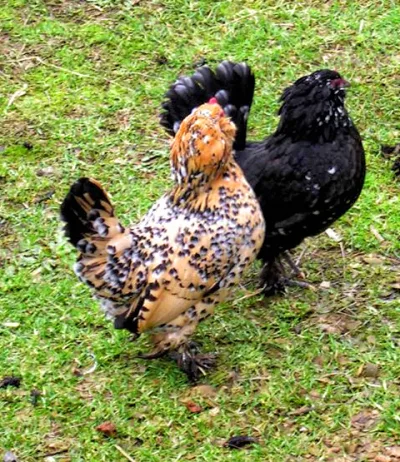
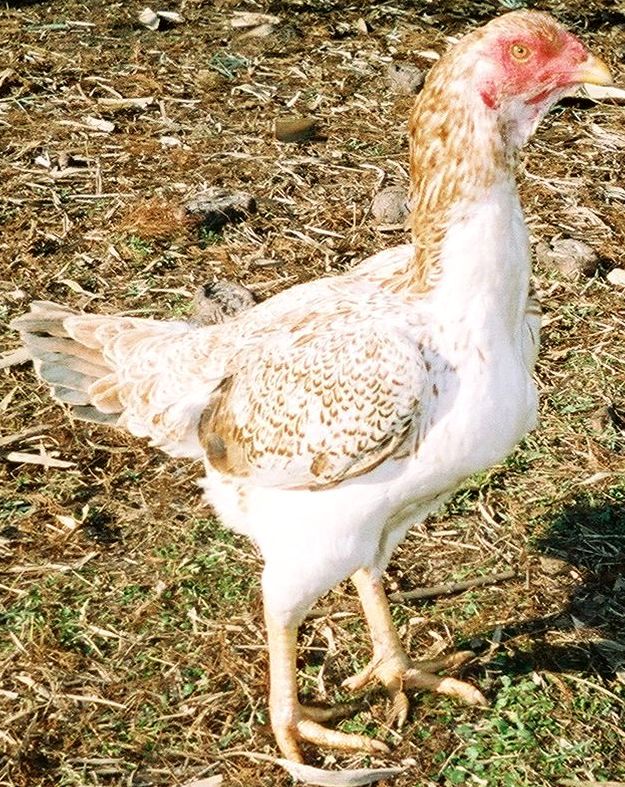
The Orloff is a breed of chicken named after Alexei Grigoryevich Orlov, a Russian Count. Reflecting this origin, it is sometimes called the Russian Orloff or simply Russian. For most of its history, the Orloff was considered to be a product of Russia and Orlov, but modern research has discovered that the breed first appeared in Persia, and was distributed across Europe and Asia by the 17th century. However, Count Orlov was a key promoter of the breed in the 19th century, and the breed became known in the West following his efforts. It was not until 1884 that the first Orloff chickens were imported to Central Europe from the Russian Empire. In some sources they are also called "Orloff fighters" (lat. Gallus dom. pugnax, barbatus). A reddish-brown cock and five hens of the same color reached the Saxon professor Friedrich Zürn (1835-1900) in Leipzig. A yellowish, slightly white speckled cock with two hens as well as two white hens came again into the possession of Baron Ludwig von Villa-Secca Navarro d'Andrade (1822-1894) to Vienna-Ottakring. Baron Villa-Secca was at that time vice-president of the Club of German and Austrian-Hungarian Poultry Breeders (today's Bund Deutscher Rassegeflügelzüchter; BDRG). Orloffs were first introduced to Great Britain in the 1920s, and were also refined a good deal in Germany; Germans created the first miniaturized bantam Orloff by 1925. The breed was once included in the American Poultry Association's breed standard, the Standard of Perfection, but it was removed due a lack of interest from breeders. In the 21st century, the Orloff remains a rare breed in the West. The Livestock Conservancy lists the breed as critically endangered. The Orloff is a tall, well-feathered chicken with a somewhat game-like appearance. The head and neck are very thickly feathered. They appear in several recognized color varieties: Black, White, Spangled, Black-tailed Red, Mahogany, and Cuckoo. Their plumage, combined with their tiny walnut comb, small earlobes and minuscule wattles, makes the Orloff a very cold-hardy breed. Males generally weigh 3.6 kilograms (7.9 lb) and hens about 3 kg (6.6 lb). Orloffs are primarily suited to meat production, but hens are reasonable layers of light brown eggs and do not usually go broody. In general temperament, they are known to be relatively calm birds.
| Life Span | 5-10 years |
| Weight | 2-5 kg |
What to Know Before Buying an Orloff
Finding a responsible Orloff breeder requires more than browsing classified ads or responding to social media posts. The USDA requires any breeder who sells chickens commercially — especially those selling online or through third-party dealers — to hold a federal license and submit to regular inspections. A legitimate breeder should be willing to provide their USDA license number, invite you to visit their facility, and show you where the animals are housed and socialized.
Before committing to a purchase, ask the breeder for veterinary health records, vaccination documentation, and any genetic testing results relevant to the Orloff. Reputable breeders will also ask you questions in return — about your living situation, experience with animals, and ability to provide long-term care. A breeder who asks no questions and is eager to ship an animal immediately is a significant red flag.
Use the search tool below to check whether any USDA-licensed facilities breeding Orloffs appear in our database. If they do, review their inspection history carefully. Look for patterns of violations, pay attention to severity levels, and compare their compliance grade with other breeders in the same state. This due diligence takes minutes and can save you from supporting a facility with documented animal welfare problems.
Looking for an Orloff breeder?
Search our database of USDA-licensed facilities to find inspected breeders and check their compliance history.
Search USDA Breeders