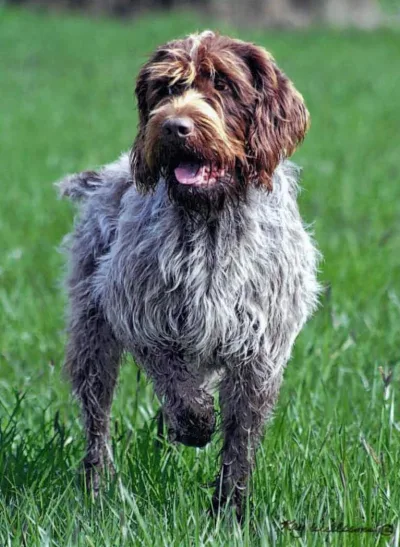
Russian Setter
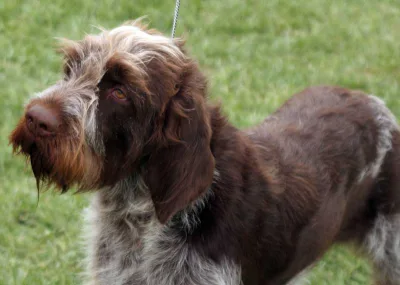
The Wirehaired Pointing Griffon (also called the Korthals Griffon and the Griffon d'arrêt à poil dur Korthals in France and Quebec) is a breed of dog used in hunting as a gundog. It is sometimes considered to be Dutch in ancestry, due to the nationality of the breed founder, Eduard Karel Korthals. History records the progression of the development of the breed through Biebesheim am Rhein, Germany where the founder established the Ipenwoud kennel and the breed type was established and then into France where it is now recognized. Others consider the Griffon to be a German breed because Korthals' kennel, Ipenwoud, was located in Biebesheim am Rhein, Germany. It was there for over twenty years that Korthals dedicated his life to the development and perfection of the Korthals Griffon. The breed is still relatively rare in the United States, Canada, and the United Kingdom despite long recognition by their respective national kennel clubs, as well as the FCI (Fédération Cynologique Internationale). The Korthals Griffon is particularly adapted for hunting in thick undergrowth and around water, where its harsh coat is excellent protection. The griffon is used primarily as a hunting dog for upland game birds as well as waterfowl.
| Life Span | 10-14 years |
| Weight | 10-30 kg |
What to Know Before Buying a Russian Setter
Finding a responsible Russian Setter breeder requires more than browsing classified ads or responding to social media posts. The USDA requires any breeder who sells dogs commercially, especially those selling online or through third-party dealers, to hold a federal license and submit to regular inspections. A legitimate breeder should be willing to provide their USDA license number, invite you to visit their facility, and show you where the animals are housed and socialized.
Before committing to a purchase, ask the breeder for veterinary health records, vaccination documentation, and any genetic testing results relevant to the Russian Setter. Reputable breeders will also ask you questions in return, about your living situation, experience with animals, and ability to provide long-term care. A breeder who asks no questions and is eager to ship an animal immediately is a significant red flag.
Use the search tool below to check whether any USDA-licensed facilities breeding Russian Setters appear in our database. If they do, review their inspection history carefully. Look for patterns of violations, pay attention to severity levels, and compare their compliance grade with other breeders in the same state. This due diligence takes minutes and can save you from supporting a facility with documented animal welfare problems.
Looking for a Russian Setter breeder?
Search our database of USDA-licensed facilities to find inspected breeders and check their compliance history.
Search USDA Breeders