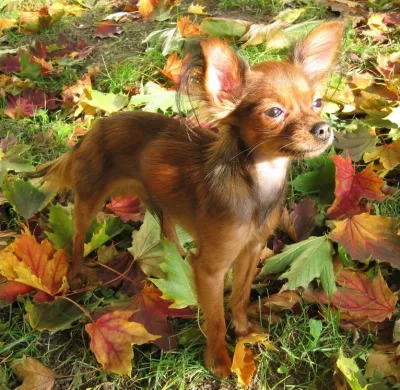
Russkiy Toy
The Russian Toy (also known as the Russian Toy Terrier, and in Russia as the Russkiy Toy, Russian: Русский той) is a very small breed of dog originally bred in Russia from the English Toy Terrier. There are two types of coats in the breed: smooth coat and long coat. The smooth-coated variety was previously known as the Russian Toy Terrier and long-coated as the Moscow Long-Haired Toy Terrier. Both were brought together under the same Russian Toy Terrier name in 1988 and the "Terrier" was dropped from the name when the breed was added in 2006 to the official list of breeds registered with the Fédération Cynologique Internationale. The breed has been registered in the Foundation Stock Service of the American Kennel Club (AKC) since 2008, and has been allowed to compete in AKC companion events since 2010. The first official breed standard of the two varieties was written in 1966 in Russia. The breed was nearly wiped out twice; first in the 1920s with the rise of Communism due to the toy dog's traditional link to the aristocracy and again in the 1990s with the influx of foreign breeds following the fall of the Iron Curtain. The smooth coat type is the older of the two types, with the long coat type first appearing in 1958. Until the 1990s, the breed was almost unknown outside of Russia, and so relatively few details on associated health issues are known. The Russian Toy was originally bred as a rat fighter and watchdog, and can still exhibit the vocalization expected from the latter. It is a friendly dog and can become very attached to the family unit. Due to its size and similarities to the Chihuahua, the two are often compared, but are not closely related.
| Life Span | 10-14 years |
| Weight | 10-30 kg |
What to Know Before Buying a Russkiy Toy
Finding a responsible Russkiy Toy breeder requires more than browsing classified ads or responding to social media posts. The USDA requires any breeder who sells dogs commercially, especially those selling online or through third-party dealers, to hold a federal license and submit to regular inspections. A legitimate breeder should be willing to provide their USDA license number, invite you to visit their facility, and show you where the animals are housed and socialized.
Before committing to a purchase, ask the breeder for veterinary health records, vaccination documentation, and any genetic testing results relevant to the Russkiy Toy. Reputable breeders will also ask you questions in return, about your living situation, experience with animals, and ability to provide long-term care. A breeder who asks no questions and is eager to ship an animal immediately is a significant red flag.
Use the search tool below to check whether any USDA-licensed facilities breeding Russkiy Toys appear in our database. If they do, review their inspection history carefully. Look for patterns of violations, pay attention to severity levels, and compare their compliance grade with other breeders in the same state. This due diligence takes minutes and can save you from supporting a facility with documented animal welfare problems.
Looking for a Russkiy Toy breeder?
Search our database of USDA-licensed facilities to find inspected breeders and check their compliance history.
Search USDA Breeders