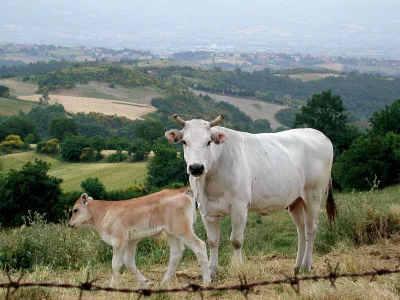
Sarlabot
The Parade of the Fat Ox, also referred to as the "Festival of the Fat Ox," "Cavalcade of the Fat Ox," "Festival of the Town Ox" (paraded through the city), or "Festival of the Violled Ox" (paraded to the sound of the viol or hurdy-gurdy), is an ancient festive tradition held during the Paris Carnival. It involves Parisian butchers or butcher boys, often adorned in costumes representing savages, sacrificers, or victims, solemnly parading one or more decorated fat oxen accompanied by music. The presence of other costumed participants and floats further augments the procession. Before the conclusion of the 20th century, the slaughter of oxen occurred after the conclusion of the festivities, with the meat subsequently being made available for commercial sale. From 1845 to the early 20th century, the animals were given names inspired by current events, popular songs, operettas, or contemporary literature. The oldest known reference to this festival dates to 1712, yet it was already regarded as ancient. Several authors claim that it is a remnant of a pagan ritual, often thought to have originated in ancient Egypt. Alternatively, some scholars have proposed that its origins lie in astrological worship, specifically the celebration of the entry of the Sun into the constellation of Taurus. Additionally, the tradition has been linked to a Lenten butcher who, upon producing the fattest ox, was granted the exclusive right to sell meat during Lent to those exempted from fasting. From a more pragmatic perspective, the Carnival and the Fat Ox symbolize a season of abundance and represent the final opportunity for feasting before the onset of the fasting period. The parade was banned during the French Revolution (1789–1799) and then revived in 1806, continuing almost uninterrupted until 1870, with a hiatus from 1848 to 1850 due to the 1848 revolution. However, France's defeat in the Franco-Prussian War (1870), the Paris Commune (1871), and legal issues led to the suspension of this tradition. The Fat Ox returned to the Carnival in 1896, albeit with intermittent participation in the early 20th century, and made a brief reappearance in 1951 and 1952. Following these events, the Fat Ox Parade and the Paris Carnival ceased to be organized, reemerging only in 1998. The Fat Ox Parade has attracted significant public attention, garnering the attention of the general public and prominent figures in the intellectual and artistic spheres. This event has served as a source of inspiration for a variety of artistic and cultural expressions, including theatrical plays, operettas, references in La traviata, political, satirical, comedic, and carnival songs, as well as poetry. Romantic literature also refers to the Fat Ox. The ox has been depicted in drawings, prints, caricatures, paintings, magic lantern slides, and photographs. The parade's popularity attracted the attention of merchants, industrialists, and politicians, who sought to use it for advertising purposes.
| Life Span | 18-22 years |
| Weight | 450-900 kg |
What to Know Before Buying a Sarlabot
Finding a responsible Sarlabot breeder requires more than browsing classified ads or responding to social media posts. The USDA requires any breeder who sells cattles commercially — especially those selling online or through third-party dealers — to hold a federal license and submit to regular inspections. A legitimate breeder should be willing to provide their USDA license number, invite you to visit their facility, and show you where the animals are housed and socialized.
Before committing to a purchase, ask the breeder for veterinary health records, vaccination documentation, and any genetic testing results relevant to the Sarlabot. Reputable breeders will also ask you questions in return — about your living situation, experience with animals, and ability to provide long-term care. A breeder who asks no questions and is eager to ship an animal immediately is a significant red flag.
Use the search tool below to check whether any USDA-licensed facilities breeding Sarlabots appear in our database. If they do, review their inspection history carefully. Look for patterns of violations, pay attention to severity levels, and compare their compliance grade with other breeders in the same state. This due diligence takes minutes and can save you from supporting a facility with documented animal welfare problems.
Looking for a Sarlabot breeder?
Search our database of USDA-licensed facilities to find inspected breeders and check their compliance history.
Search USDA Breeders