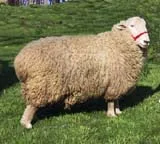
Soay sheep
The Soay sheep is a breed of domestic sheep (Ovis aries) descended from a population of feral sheep on the 100-hectare (250-acre) island of Soay in the St Kilda Archipelago, about 65 kilometres (40 mi) from the Western Isles of Scotland. It is one of the Northern European short-tailed sheep breeds. It remains physically similar to the wild ancestors of domestic sheep, the Mediterranean mouflon and the horned urial sheep of Central Asia. It is much smaller than modern domesticated sheep but hardier, and is extraordinarily agile, tending to take refuge amongst the cliffs when frightened. Soays may be solid black or brown, or more often blonde or dark brown with buffish-white underbelly and rump (known as lachdann in Scottish Gaelic, which is cognate to the Manx loaghtan); a few have white markings on the face. In the early twentieth century, some Soay sheep were relocated to establish exotic flocks, such as the flock of "Park Soay" at Woburn Abbey, established by the Duke of Bedford in 1910, and selected for "primitive" characteristics. A number of Soay sheep were translocated from Soay to another of the St Kilda group, the island of Hirta by the Marquess of Bute in the 1930s, after the human population and their sheep were evacuated. The name of the island is from Old Norse Seyðoy, meaning "Island of Sheep". The breed was introduced to and live wild on Holy Isle off Arran. Soay sheep were introduced from St Kilda to Lundy, an island in the Bristol Channel, by Martin Coles Harman soon after he purchased the island in 1925. There is also a small population living wild in and around the Cheddar Gorge in Somerset. The breed was used in experimental archaeology at Butser Ancient Farm because it closely resembles British prehistoric breeds. The Soays are particularly hardy and have been allowed to become largely feral. The breed is listed in "Category 4: At Risk" by the Rare Breeds Survival Trust, because there are only between 900 and 1500 registered breeding Soay ewes. The Soay is distinct from two other short-tailed breeds also associated with St Kilda: the Boreray (from Boreray, another of the islands, and formerly also living on Hirta), and the "St Kilda", a former name for the Hebridean sheep (which is probably not from St Kilda at all).
| Life Span | 10-12 years |
| Weight | 45-160 kg |
What to Know Before Buying a Soay sheep
Finding a responsible Soay sheep breeder requires more than browsing classified ads or responding to social media posts. The USDA requires any breeder who sells sheeps commercially — especially those selling online or through third-party dealers — to hold a federal license and submit to regular inspections. A legitimate breeder should be willing to provide their USDA license number, invite you to visit their facility, and show you where the animals are housed and socialized.
Before committing to a purchase, ask the breeder for veterinary health records, vaccination documentation, and any genetic testing results relevant to the Soay sheep. Reputable breeders will also ask you questions in return — about your living situation, experience with animals, and ability to provide long-term care. A breeder who asks no questions and is eager to ship an animal immediately is a significant red flag.
Use the search tool below to check whether any USDA-licensed facilities breeding Soay sheeps appear in our database. If they do, review their inspection history carefully. Look for patterns of violations, pay attention to severity levels, and compare their compliance grade with other breeders in the same state. This due diligence takes minutes and can save you from supporting a facility with documented animal welfare problems.
Looking for a Soay sheep breeder?
Search our database of USDA-licensed facilities to find inspected breeders and check their compliance history.
Search USDA Breeders