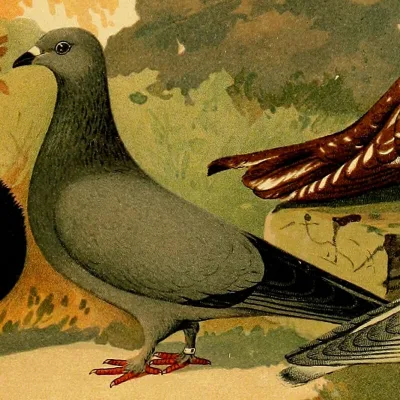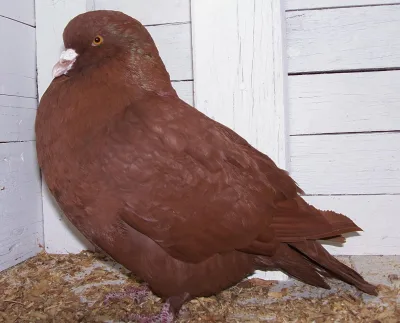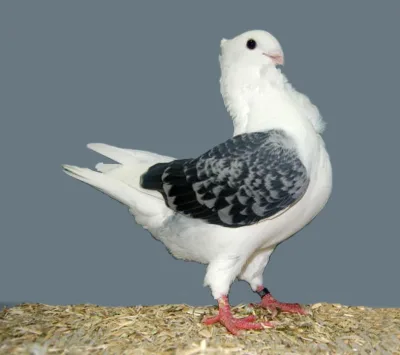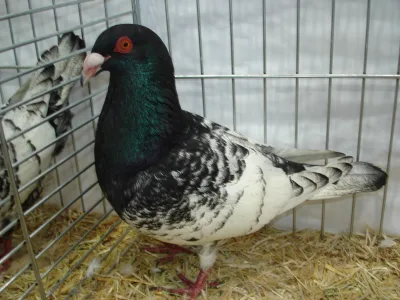
Spanish Pigeon
The homing pigeon is a variety of domestic pigeon (Columba livia domestica), selectively bred for its ability to find its way home over extremely long distances. Because of this skill, homing pigeons were used to carry messages, a practice referred to as "pigeon post". Until the introduction of telephones, they were used commercially to deliver communication; when used during wars, they were called "war pigeons". The homing pigeon is also called a mail pigeon or messenger, and colloquially a homer. Perhaps most commonly, the homing pigeon is called a carrier pigeon; this nomenclature can be confusing, though, since it is distinct from the English carrier, an ancient breed of fancy pigeon. Modern-day homing pigeons do have English carrier blood in them because they are in part descendants of the old-style carriers. The domestic pigeon is derived from the wild rock dove (Columba livia sspp.); the rock dove has an innate homing ability, meaning that it will generally return to its nest using magnetoreception. Flights as long as 1,800 km (1,100 miles) have been recorded by birds in competitive homing pigeon racing; birds bred for this are colloquially called racing homers. Homing pigeons' average flying speed over moderate 965 km (600 miles) distances is around 97 km/h (60 miles per hour) and speeds of up to 160 km/h (100 miles per hour) have been observed in top racers for short distances.
| Life Span | 6-15 years |
| Weight | 0.2-0.5 kg |
What to Know Before Buying a Spanish Pigeon
Finding a responsible Spanish Pigeon breeder requires more than browsing classified ads or responding to social media posts. The USDA requires any breeder who sells pigeons commercially, especially those selling online or through third-party dealers, to hold a federal license and submit to regular inspections. A legitimate breeder should be willing to provide their USDA license number, invite you to visit their facility, and show you where the animals are housed and socialized.
Before committing to a purchase, ask the breeder for veterinary health records, vaccination documentation, and any genetic testing results relevant to the Spanish Pigeon. Reputable breeders will also ask you questions in return, about your living situation, experience with animals, and ability to provide long-term care. A breeder who asks no questions and is eager to ship an animal immediately is a significant red flag.
Use the search tool below to check whether any USDA-licensed facilities breeding Spanish Pigeons appear in our database. If they do, review their inspection history carefully. Look for patterns of violations, pay attention to severity levels, and compare their compliance grade with other breeders in the same state. This due diligence takes minutes and can save you from supporting a facility with documented animal welfare problems.
Looking for a Spanish Pigeon breeder?
Search our database of USDA-licensed facilities to find inspected breeders and check their compliance history.
Search USDA Breeders