Königsberger Paukenhund
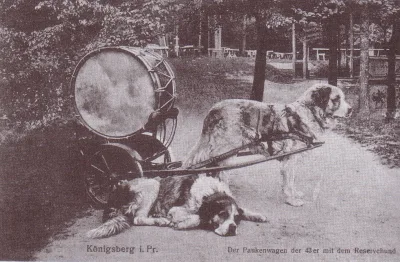
The Königsberger Paukenhund was the traditional kettle drum dog of the Prussian infantry based in the East Prussian capital of Königsberg. The tradition dates from the 1866 Battle of Königgrätz, where troops of the Prussian 43rd Infantry Regiment ("Duke Karl of Mecklenburg-Strelitz") overran the drum wagon of the Austrian 77th Infantry Regiment ("Karl Salvator of Tuscany"), whose dog, a Saint Bernard named "Sultan", had been shot. The East Prussian soldiers took the drum wagon back on their victorious return to Königsberg, where it received much attention. There, dogs were assigned to the regiment. As part of the musical corps, the dogs, named either "Sultan" or "Pasha" in honor of their Austrian predecessor, participated in parades and the procession of the castle guard until after the First World War. Following the establishment of the Weimar Republic and founding of the Reichswehr, the soldiers asked for restoration of the Paukenhund tradition. A businessman named Kalitzki donated a Saint Bernard dog to the newly formed 1st (Prussian) Infantry Regiment. The last Königsberger Paukenhund was killed in April 1945 by his caretaker as the Red Army encircled Königsberg. The caretaker also shot his wife and their children before turning the gun upon himself.
| Life Span | 10-14 years |
| Weight | 10-30 kg |
What to Know Before Buying a Königsberger Paukenhund
Finding a responsible Königsberger Paukenhund breeder requires more than browsing classified ads or responding to social media posts. The USDA requires any breeder who sells dogs commercially, especially those selling online or through third-party dealers, to hold a federal license and submit to regular inspections. A legitimate breeder should be willing to provide their USDA license number, invite you to visit their facility, and show you where the animals are housed and socialized.
Before committing to a purchase, ask the breeder for veterinary health records, vaccination documentation, and any genetic testing results relevant to the Königsberger Paukenhund. Reputable breeders will also ask you questions in return, about your living situation, experience with animals, and ability to provide long-term care. A breeder who asks no questions and is eager to ship an animal immediately is a significant red flag.
Use the search tool below to check whether any USDA-licensed facilities breeding Königsberger Paukenhunds appear in our database. If they do, review their inspection history carefully. Look for patterns of violations, pay attention to severity levels, and compare their compliance grade with other breeders in the same state. This due diligence takes minutes and can save you from supporting a facility with documented animal welfare problems.
Looking for a Königsberger Paukenhund breeder?
Search our database of USDA-licensed facilities to find inspected breeders and check their compliance history.
Search USDA Breeders