Whippet
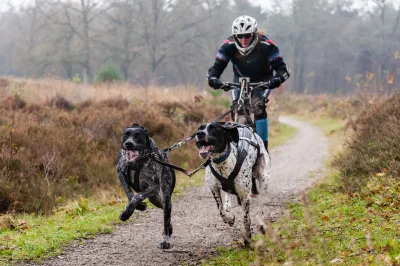
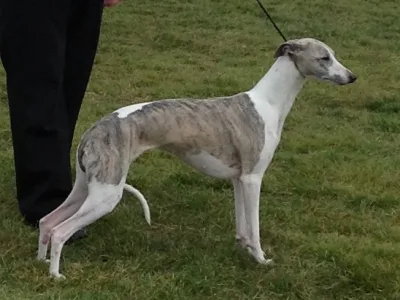
The Whippet is a British breed of sighthound. It closely resembles the Greyhound and the smaller Italian Greyhound, and is intermediate between them in size. In the nineteenth century, it was sometimes called "the poor man's racehorse". It is commonly kept as a companion dog, for competitive showing or for amateur racing, and may participate in various dog sports, including lure coursing, agility, and flyball. It has the fastest running speed within its weight and size range, and is believed to have the fastest idle-to-running acceleration of any dog. Whippets are characterized by their gentle, affectionate, and calm temperament. While typically relaxed and serene at home, they exhibit high energy and excitement when outdoors. Originally bred as hunting and racing dogs, Whippets have a strong prey drive, which may lead them to chase small animals. Whippets have a minimal-shedding coat that is easy to manage due to its short, smooth texture and lack of an undercoat. However, their short coat and low body fat make them particularly sensitive to cold temperatures, so they may require extra protection, such as a dog jacket, in cooler weather. The breed is generally healthy, benefiting from a strong, athletic constitution, and is free from many hereditary issues seen in other breeds. The concept of greyhound-type dogs of various sizes—large, medium, and small—has been well-documented in hunting manuals and natural history works dating back to the Middle Ages. In the early 15th century, Edward of Norwich, 2nd Duke of York, translated and expanded the late 14th-century French Livre de chasse, a comprehensive manual on instructions for hunting with dogs. In his work, he highlighted the benefits of keeping ‘great,’ ‘middle,’ and ‘small-sized Greyhounds’ for hunting different kinds of game. Later, in the 16th century, English physician and academic John Caius referenced both greater and lesser types of Leporarius, Grehounde (Greyhound) in his book De Canibus Britannicis. Notably, he described a type connected to the Whippet: the tumbler, a 'lesser sort of mungrell greyhounde' that was an excellent warren dog used for catching rabbits. The tumbler was also recorded by Thomas Brown, a Scottish curator and editor, in the early 19th century.
| Origin | England |
| Life Span | 12-15 years |
| Weight | 6-14 kg |
What to Know Before Buying a Whippet
Finding a responsible Whippet breeder requires more than browsing classified ads or responding to social media posts. The USDA requires any breeder who sells dogs commercially, especially those selling online or through third-party dealers, to hold a federal license and submit to regular inspections. A legitimate breeder should be willing to provide their USDA license number, invite you to visit their facility, and show you where the animals are housed and socialized.
Before committing to a purchase, ask the breeder for veterinary health records, vaccination documentation, and any genetic testing results relevant to the Whippet. Reputable breeders will also ask you questions in return, about your living situation, experience with animals, and ability to provide long-term care. A breeder who asks no questions and is eager to ship an animal immediately is a significant red flag.
Use the search tool below to check whether any USDA-licensed facilities breeding Whippets appear in our database. If they do, review their inspection history carefully. Look for patterns of violations, pay attention to severity levels, and compare their compliance grade with other breeders in the same state. This due diligence takes minutes and can save you from supporting a facility with documented animal welfare problems.
Looking for a Whippet breeder?
Search our database of USDA-licensed facilities to find inspected breeders and check their compliance history.
Search USDA Breeders